Hadrian’s Arch in Athens: History, Design and Visiting Notes
Hadrian's Arch in Athens was built in 131 or 132 AD beside the Temple of Olympian Zeus. Here is its history, design and how to fit it into a Roman Athens walk.
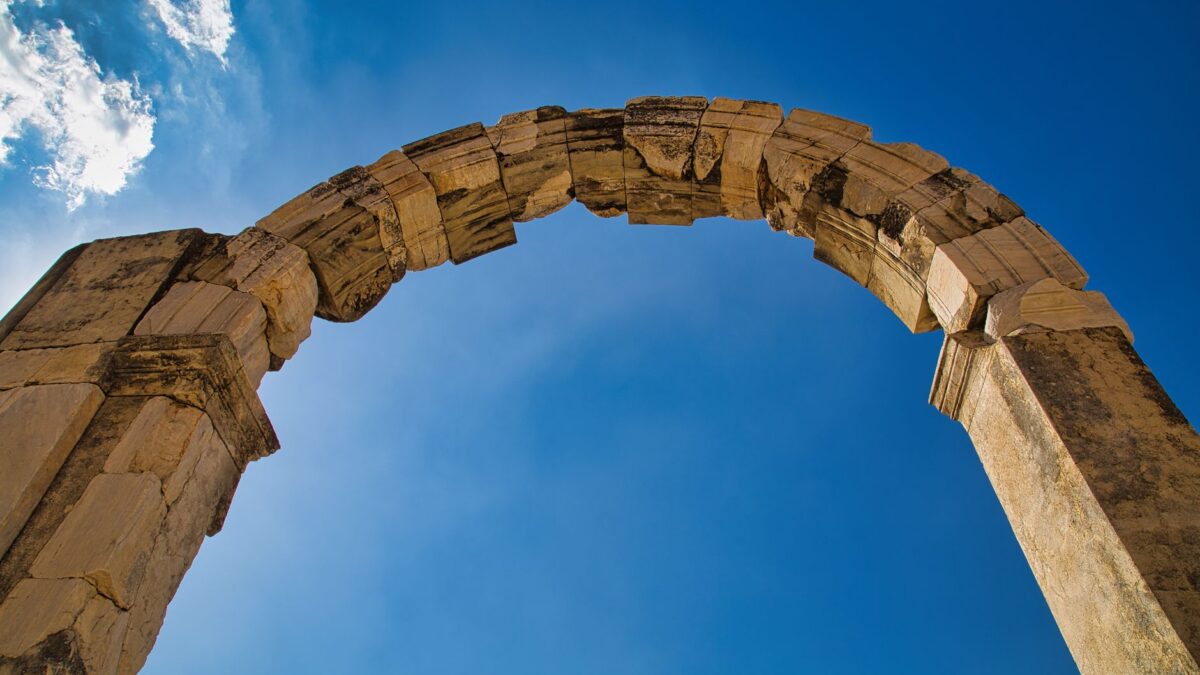
The Arch of Hadrian in Athens is a marble gateway built in 131 or 132 AD, probably to mark the Roman emperor Hadrian’s visit and the dedication of the nearby temple complex. It stands on public land, is open to visitors and sits 325 metres southeast of the Acropolis, on the road that once ran from the old centre of Athens toward the Temple of Olympian Zeus.
Greeks usually call it Pyli tou Adrianou (Hadrian’s Gate). Its design, history and inscriptions still divide scholars, which is part of its appeal.
Who was Hadrian and why did Athens matter to him?
According to Wikipedia’s entry on Hadrian, he ruled the Roman Empire from 117 to 138. He was born in Italica, in present-day Spain, and he visited almost every province of the empire. He preferred building projects and direct involvement in imperial affairs to new conquests.
Hadrian admired Greek culture so much that he promoted Athens as the cultural capital of the empire. A promoter of philhellenism (love of Greek culture), he was nicknamed “Graeculus” in youth, a mild mockery meaning “Greekling”. He also rebuilt the Pantheon in Rome, and the same entry names him as the builder of the Temple of Venus and Roma and the Villa Adriana in Tivoli. In Athens his name is attached to a gateway, a temple complex and a library, covered below.
What is the Arch of Hadrian and what did it celebrate?
The Arch of Hadrian resembles a Roman triumphal arch in some respects, but it is a single gateway. It has been proposed that the citizens of Athens built it to celebrate the adventus (arrival) of the emperor and to thank him for his many gifts to the city. Nobody can say for certain who commissioned it.
Two inscriptions faced in opposite directions and named both Theseus and Hadrian as founders of Athens. Scholars agree that the texts honour Hadrian. They disagree on whether the words refer to the city as a whole or to two parts of it, one old and one new. One scholar, Kouremenos, argues that the inscriptions honour Hadrian as an Athenian, since he had become an Athenian citizen nearly two decades before the monument went up.
An older idea held that the arch marked the line of the ancient city wall. Further excavation has shown that to be false.
How is the arch built?
The whole monument is made of Pentelic marble from Mount Pentelicus, 18.2 km northeast of the arch. The same stone was used for the Parthenon, though the marble in the arch is of a lower grade with more inclusions. Builders used no cement or mortar. They cut solid marble blocks and joined them with clamps.
- Height: 18 m
- Width: 13.5 m
- Depth: 2.3m
- Width of the single arched passageway on the lower level: 6.5m
The design is symmetrical front to back and side to side. The lower level has Corinthian columns on raised bases on either side of the passageway. The upper level, called the attic, is divided into three openings by columns and pilasters, and the central one has a triangular pediment above it.
Roman triumphal arches usually have a massive, solid attic carrying a dedication and sculpture, and often a chariot group on top. The Athenian arch has a lighter upper level that could not carry large decoration. Its central opening was once closed by a thin stone screen about 7 cm thick, and only the mounting slots survive. One account credits Queen Amalia with ordering the screen removed for aesthetic reasons, and the avenue beside the arch carries her name. Another scholar proposed that all three openings were closed, but that view has not prevailed.
What stood on top of the arch?
Scholars disagree. Some proposed statues of Theseus and Hadrian on the lower level, flanking the central niche, and possibly more statues in the attic. Another scholar, Willers, found no sign of the doweling needed to fix statues and describes the stone as too roughly worked for them. Willers studied only the lower level closely, because permission to study the upper level was not granted. Kouremenos suggests the arch held painted reliefs in Hadrian’s time, possibly with statues in the central opening, and that these were taken down and replaced in the Byzantine period. The sources say a complete investigation of the monument remains to be done.
How does the arch connect to the Temple of Olympian Zeus?
The arch spanned an ancient road leading to the complex on the eastern side of the city that included the Temple of Olympian Zeus. Wikipedia lists several ancient Greek temples with this name, so searchers should look for the one in Athens. Its dedication in 131 or 132 AD is the occasion the arch is thought to commemorate.
How can you fit it into a Roman Athens day?
The arch lies on the eastern side of the old centre, so it works as an end point for a day that begins at the Roman market. The Roman Athens walk covers the Roman Agora, the library and the Tower of the Winds. Visitors who want the older streets can pair it with the Plaka guide. Opening hours and ticket rules for the temple site are not in the pages used here, so check the Ministry of Culture’s official pages before going. The arch itself is public property managed by the Minister for Culture, and public access is listed as yes.
Quick answers
When was the Arch of Hadrian built?
In 131 or 132 AD, around the time the nearby temple complex was dedicated.
What is it made of?
Pentelic marble, assembled without mortar and held together with clamps.
Is the arch a triumphal arch?
It resembles one in some respects, and it has a single passageway. Its light upper level differs from the heavy attic of typical Roman examples.
Where is it?
325 metres southeast of the Acropolis, on the old road toward the Temple of Olympian Zeus.
Checked against official sources in November 2026. Hours, prices and rules change: confirm on the official page before you go or apply.