History of the Acropolis: What Was Built When, Step by Step
The Acropolis went from a Mycenaean fortress to the home of the Parthenon. See what stood on the rock in each period and when the damage came.
The Acropolis of Athens began as a Mycenaean fortress in the late Bronze Age, gained temples under the Archaic tyrants, and received its famous marble buildings in the fifth century BC under Pericles. The Parthenon, begun in 447 BC, is the best known of them. Most of the site you see today dates from that Periclean program, and much of the damage dates from a Venetian bombardment in 1687.
The sections below follow the rock in order, using the encyclopedia entries on the Acropolis of Athens and the Parthenon.
How long has the hill been inhabited?
People lived on the hill as early as the 4th millennium BC, and the oldest artifacts found there belong to the Middle Neolithic. The rock is a flat-topped outcrop that rises about 150 m above sea level, with a surface of roughly 3 ha. Habitation elsewhere in Attica is documented even earlier, from the 6th millennium BC.
What did the Mycenaeans build on the Acropolis?
Scholars have little doubt that a palace with a megaron, the large central hall typical of Mycenaean palaces, stood on the summit in the late Bronze Age. Almost nothing survives of it, probably just one limestone column base and parts of some sandstone steps.
Soon after the palace came a massive defensive circuit known as the Cyclopean wall, up to 10 m high. It followed the natural contour of the rock, and its gate on the south side was set at an angle so that defenders above could cover attackers approaching. From the end of the Late Helladic IIIB period, which ran from 1300 to 1200 BC, this wall was the citadel’s main defense until the 5th century. A crack opened by an earthquake near the northeastern edge, before the 13th century BC, led to a well. Builders added an elaborate stair, and the well gave defenders protected drinking water during sieges.
What happened in the Archaic period?
Little is known about how the Acropolis looked before the Archaic era. In the 7th and 6th centuries BC, Kylon seized the site in a failed coup, and Peisistratos took it twice. Peisistratos also built an entry gate. A wall with nine gates, the Enneapylon, probably encircled the hill and enclosed the large Clepsydra spring at the northwest foot.
A temple to Athena Polias, the city’s protective goddess, went up between 570 and 550 BC. It was a limestone building in the Doric style, called the Hekatompedon, meaning “hundred-footed.” Many of its remains survive. It probably stood where the Parthenon is today. A second temple, the Old Temple of Athena, followed between 529 and 520 BC, set between the later Erechtheion and the Parthenon.
What was the Older Parthenon?
Around 500 BC the Hekatompedon was taken down for a larger building, the Older Parthenon. Athenians stopped work on the Olympieion, a temple tied to the tyrant Peisistratos and his sons, and used its Piraeus limestone for the new temple. Builders leveled the south part of the summit with some 8,000 two-ton blocks of limestone. The foundation reaches 11 m deep in places.
After the victory at the Battle of Marathon in 490 BC, the plan changed and marble replaced limestone. Scholars call the limestone stage Pre-Parthenon I and the marble stage Pre-Parthenon II. Work paused in 485 BC when Xerxes became king of Persia and war looked likely. Persian forces sacked the city in 480 BC while the temple was unfinished and burned it, along with the Old Temple and nearly everything else on the rock. The Old Temple was destroyed in the Persian invasion of 480 to 479 BC, though it was probably rebuilt by 454 BC.
When was the Parthenon built?
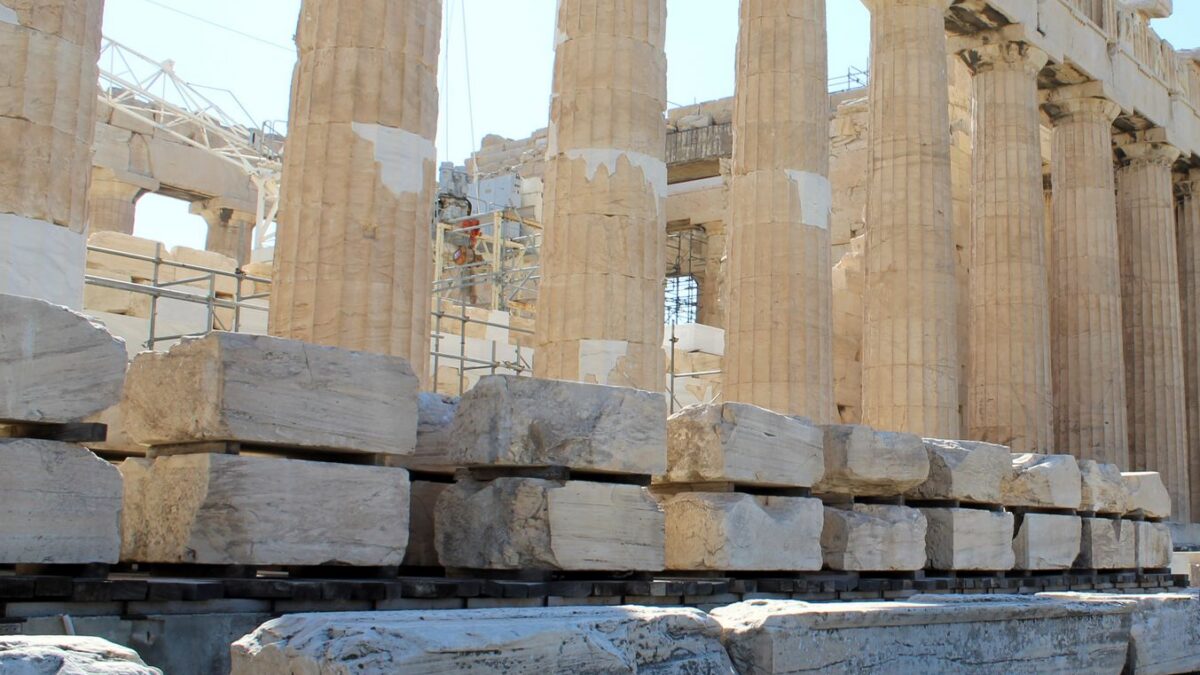
The Parthenon was built in the 5th century BC in thanks for the Greek victory in the Greco-Persian Wars. Construction began in 447 BC, when the Delian League was at its strongest. The building was finished in 438 BC, and work on its sculpture and decoration went on until 432 BC. Iktinos and Callicrates were the architects and Phidias the sculptor. It is made of Pentelic marble and measures 69.5 by 30.9 m on its base. Like most Greek temples it also served as a treasury, and for a time held the funds of the Delian League.
The same program produced the Propylaea, the Erechtheion and the Temple of Athena Nike. Pericles coordinated this work, according to the encyclopedia entry.
What changed after antiquity?
In the last decade of the 6th century AD, the Parthenon became a church dedicated to the Virgin Mary. After the Ottoman conquest in the mid-15th century it became a mosque. During the Venetian siege of 1687, in the Morean War, a bomb hit the building, which the Ottomans were using to store gunpowder. The explosion severely damaged the Parthenon and other buildings on the rock.
From 1800 to 1803, the 7th Earl of Elgin removed many surviving sculptures and shipped them to England, where they are known as the Elgin Marbles or Parthenon marbles. The removal remains controversial. Since 1975, large restoration projects have worked to preserve what remains. The Acropolis was inscribed as a UNESCO World Heritage Site in 1987.
Visiting the Acropolis today
Planning a visit? Our guide to Acropolis tickets, free entry days and opening hours covers the practical side, and the Acropolis Museum guide explains what to see in the museum below the rock. If you want to stay nearby, read about living in Koukaki.
Quick answers
Who ordered the Parthenon built?
Pericles coordinated the fifth-century building program on the Acropolis, which included the Parthenon.
Was the Parthenon always a temple?
No. It was a temple to Athena, then a Christian church to the Virgin Mary from the final decade of the 6th century AD, and later a mosque after the Ottoman conquest.
What destroyed the roof and walls of the Parthenon?
A Venetian bomb in 1687 set off gunpowder stored inside by the Ottoman rulers.
Checked against official sources in November 2026. Hours, prices and rules change: confirm on the official page before you go or apply.