Why Athens Is Named After Athena: The Olive Tree Myth Explained
Athens takes its name from Athena, who beat Poseidon by creating the first olive tree. Scholars now say the goddess took her name from the city.
In the founding myth of Athens, the goddess Athena won patronage of the city from Poseidon by creating the first olive tree, and the city took her name in return. Modern scholars read the naming the other way round: the goddess most likely got her name from the city. Both versions appear in the sources below, and both are worth knowing if you are standing on the Acropolis.
What is the myth of Athena and Poseidon?
The story is a contest over who would protect the city. According to Wikipedia’s article on Athena, she bested Poseidon by creating the first olive tree. The god of the sea lost, and Athens became her city.
The ancient tellings add scenery that the sources here do not spell out, such as the gifts each god offered and the judge who decided. Poseidon’s side of the story is usually told with his trident striking the rock of the Acropolis. If you want a full version, read it in a translation of an ancient author rather than relying on a retelling.
Was Athens named after Athena, or the other way round?
Ancient scholars argued about it. Today most scholars agree that the goddess takes her name from the city. One reason is the ending -ene, which is common in names of places and rare in personal names.
The city’s name in ancient Greek is Athenai, a plural form. According to myth, it marked the place where she presided over the Athenai, a sisterhood devoted to her worship. Other cities had similar patrons that were named after them. Mycenae had a goddess called Mykene, and Thebes had Thebe, whose city name appears in the plural form Thebai.
The name Athenai is also likely to be pre-Greek in origin, so the question of who named whom goes back to before the Greek language reached the region.
Why did the Greeks tell a story about winning a city?
Athena was regarded as the patron and protectress of various cities across Greece, and Athens above all. She was called Polias and Poliouchos, both derived from polis, the word for a city-state, and her temples usually stood on the fortified acropolis at the centre of a city. The Parthenon on the Athenian Acropolis is dedicated to her.
The contest myth gave this bond a reason. A city that depended on olives could say its goddess had earned the place, and the olive tree remained one of her symbols alongside the owl, the snake and the helmet.
Who was Athena in the first place?
She is a goddess of wisdom, warfare and handicraft, and a member of the twelve Olympians. In Greek mythology she was born from the forehead of her father Zeus. In Hesiod’s Theogony this happened after Zeus swallowed his consort Metis while she was pregnant.
Her roots may be older than the city-state. Athena was originally an Aegean palace goddess who presided over household crafts and protected the king. A Linear B tablet from Knossos reads a-ta-na po-ti-ni-ja, often translated as “Mistress Athena.” It could also mean the Lady of Athens, but any link to the city of Athens in that inscription is uncertain.
The philosopher Plato (428 to 347 BC) offered his own explanations of her name in the dialogue Cratylus, tying it to the mind and to divine intelligence. The source describes these as rather imaginative. For the history of Athenian thought, see the trial of Socrates.
Where can you see the contest on the Acropolis today?
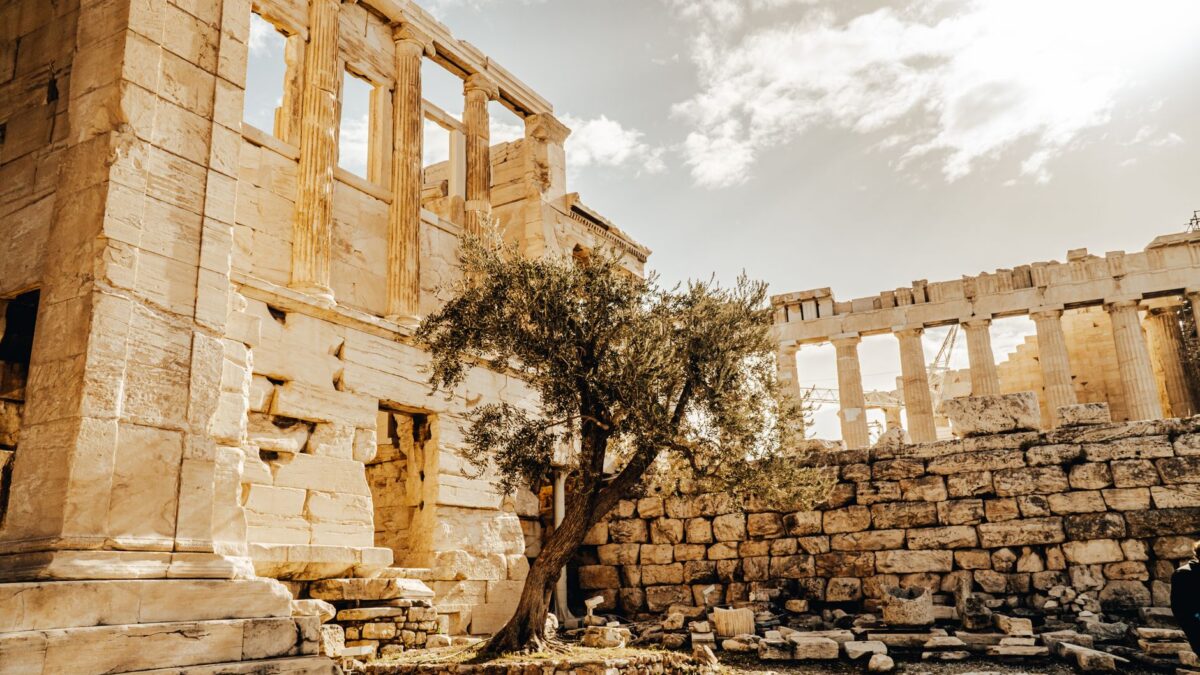
The Erechtheion, a temple on the north side of the Acropolis, is the place most tied to the rivalry. The Erechtheion was primarily dedicated to Athena and housed the statue of Athena Polias. Its name refers to the sanctuary of Erechtheus or Poseidon.
The joint cult of Athena and Poseidon-Erechtheus appears to have been established on the Acropolis at a very early period. Some reconstructions of an earlier temple on the site place the “trident marks” in its porch. The sources do not say what the marks looked like, and scholars have not settled the layout of the cults inside the building.
The building is also unusual. Its asymmetrical plan does not follow the canon of Greek classical architecture. It was traditionally dated to about 421 to 406 BCE, though recent scholarship favours a start in the 430s. The architect is possibly Mnesikles, and the building is now a museum owned by the Greek government.
Practical tips for visitors
- Check opening hours and ticket prices on the official site of the Acropolis before you go, since neither source covers them.
- Read about the Erechtheion before you climb up. The building’s purpose is still debated, so a printed or downloaded note helps more than a guess at the signs.
- Look for the olive tree associated with Athena’s gift. Which tree the sources have in mind is not stated, so treat any labelled tree as tradition rather than proof.
- Visiting in winter? The Christmas in Athens guide covers shop hours and customs for the season.
Quick answers
Who won the contest between Athena and Poseidon?
Athena. She created the first olive tree and secured patronage of the city.
Is Athena really the source of the city’s name?
Probably not. Scholars generally agree that the goddess takes her name from the city, and the myth reverses the order.
Which Acropolis temple is linked to both gods?
The Erechtheion, where Athena and Poseidon-Erechtheus appear to have shared a cult from an early period.
Is the Parthenon also Athena’s temple?
Yes. The Parthenon on the Athenian Acropolis is dedicated to her, along with other temples and monuments.
Checked against official sources in November 2026. Hours, prices and rules change: confirm on the official page before you go or apply.