Battle of Marathon and the Marathon Race: From Legend to Olympics
The marathon race is named after the Battle of Marathon in 490 BC. The battle, the runner legend and the 1896 Athens revival explained.
The marathon race is named after the Battle of Marathon, fought in 490 BC on a coastal plain in northeast Attica, where Athenians and a small force from Plataea defeated a Persian army. The story of a messenger running from the battlefield to Athens is a later legend. The race itself was invented for the first modern Olympic Games, held in Athens in 1896.
What happened at the Battle of Marathon?
The battle ended the first Persian invasion of Greece. According to the Wikipedia article on the Battle of Marathon, it is dated to Sept. 12, 490 BC (6 Boedromion in the Athenian calendar), and the Persian force was led by Datis and Artaphernes on behalf of King Darius I.
The Athenians and their allies picked ground with marshes and mountains, which kept the Persian cavalry from joining up with the infantry. Their general, Miltiades, strengthened his two wings and let the Persians push into his center. The wings then turned inward and closed around the Persian troops, who broke and ran for their ships. Many were killed on the way. Herodotus, the ancient historian of the war, counted 192 Athenians dead against 6,400 on the Persian side.
Why did Persia attack Athens?
Athens and Eretria had sent troops to help the Greek cities of Ionia, on the coast of today’s Turkey, rebel against Persian rule. Together they captured and burned Sardis, a Persian regional capital, before retreating. Herodotus writes that Darius swore revenge and had a servant remind him of the Athenians three times before dinner every day.
There was also a political thread. In 510 BC the Athenians, helped by the Spartan king Cleomenes I, drove out the tyrant Hippias. Hippias fled to Sardis and offered the Persians control of Athens if they put him back in power.
After the Persians crushed the Ionian cities at the Battle of Lade in 494 BC, Darius sent a fleet across the Aegean in 490 BC. It took the Cyclades, besieged and captured Eretria on Euboea, then landed in the bay near Marathon. Athens asked Sparta for help, but the Spartans were in the middle of a religious festival and did not come in time.
What happened after the battle?
The Persian force sailed back to Asia. Darius began raising a much larger army, but a revolt in Egypt in 486 BC put the plan on hold. His son Xerxes I launched the second invasion of Greece in 480 BC. For the Greeks, Marathon was proof that the Persians could be beaten, and that Athens could win a major battle without Sparta, which was then seen as the strongest military power in Greece.
Did a runner really carry the news to Athens?
Probably not in the form most people know. The popular story says a messenger named Pheidippides fought at Marathon, saw Persian ships turning toward Athens, and ran the whole way without stopping. He threw off his weapons and clothes, burst into the assembly to announce the victory and then collapsed and died.
The Wikipedia article on the marathon traces this tale to much later writers. The first known account of a run from Marathon to Athens comes from Plutarch’s On the Glory of Athens, written in the first century AD, which quoted a lost work by Heraclides Ponticus and named the runner as Thersipus of Erchius or Eucles. The satirist Lucian of Samosata wrote a version close to the modern one, but his playful tone and his use of the name Philippides make historians doubt it.
Herodotus, the main source on the war, tells a different story. His runner, Philippides, ran from Athens to Sparta to ask for help and then ran back, more than 240 kilometres each way. Herodotus does not mention any messenger from Marathon to Athens. Instead, he says the Athenian army, worried that the Persian fleet would raid the undefended city, marched home from the battlefield the same day.
The legend took its modern shape in 1879, when the English poet Robert Browning published his poem Pheidippides. By the late 19th century many readers treated it as history.
Which route would the runner have taken?
Mount Pentelicus stands between Marathon and Athens, so a runner had to go around it. The southern route, the more obvious one, follows the coast south from Marathon Bay, climbs slowly west between the foothills of Hymettus and Penteli, and then drops gently into Athens. Today’s Marathon to Athens highway (EO83 and EO54) runs along it. In 1896 this road was about 40 kilometres long, and early marathon races used roughly that distance.
A second possible route climbs west along the slopes of Mount Penteli to the pass of Dionysos and then heads straight downhill to Athens. It is shorter, at 35 kilometres, but the first 5 kilometres are a very steep climb.
How was the marathon revived in 1896?
The French philologist Michel Bréal proposed a long road race for the first modern Olympics in Athens, as an event that would recall ancient Greece. Pierre de Coubertin, founder of the modern Games, backed the idea, and so did the Greeks.
A qualifying race was run on March 22, 1896, and Charilaos Vasilakos won it in 3 hours and 18 minutes. The Olympic marathon took place on April 10, 1896, and was won by Spyridon Louis, a Greek water-carrier, in 2 hours 58 minutes and 50 seconds. Only men could enter. The women’s Olympic marathon did not start until 1984.
The distance was not fixed until 1921. Today it is 42.195 kilometres, and more than 800 marathons are held around the world each year.
Can you still run or watch the original course?
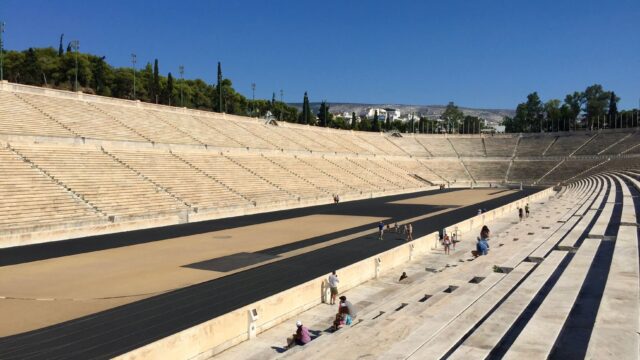
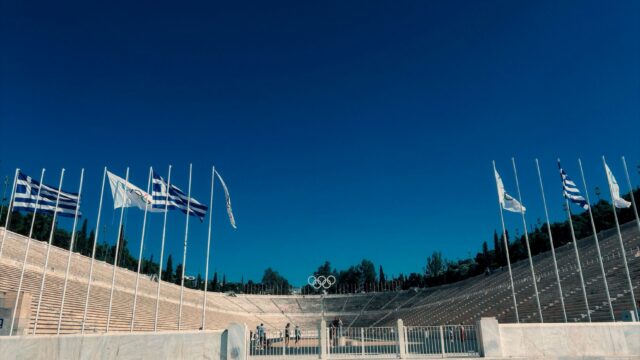
Yes. The 2004 Athens Olympics used the traditional route from Marathon, finishing at the Panathinaiko Stadium, which had also hosted the 1896 Games. Italian runner Stefano Baldini won the men’s race in 2 hours 10 minutes and 55 seconds. That stood as the course record until the 2014 Athens Classic Marathon, when Felix Kandie ran 2 hours 10 minutes and 37 seconds. The Athens Classic Marathon still runs from Marathon to the Panathinaiko each year, and our guide to the Athens Classic Marathon route, finish and best places to watch covers race day in the city.
Quick answers
When was the Battle of Marathon?
In 490 BC. The traditional date is Sept. 12, during the first Persian invasion of Greece.
How many soldiers died at Marathon?
Herodotus gives 192 Athenian dead and 6,400 Persian dead.
Was Pheidippides a real person?
Herodotus names a runner, Philippides, who ran from Athens to Sparta and back. The story of a fatal run from Marathon to Athens first appears centuries later, in Plutarch.
Who won the first Olympic marathon?
Spyridon Louis of Greece, on April 10, 1896, in 2 hours 58 minutes and 50 seconds.
Checked against official sources in November 2026. Hours, prices and rules change: confirm on the official page before you go or apply.