Earthquakes in Athens: What to Do Before, During and After a Quake
Most quakes felt in Athens are small and far away, but the 1999 Parnitha earthquake showed what a nearby one can do. Here is the official advice, translated into steps for an Athens flat.
Athens sits in one of Europe’s most seismic countries, and people in Attica feel small earthquakes several times a year, most of them centered at sea or in neighboring regions. The worst in living memory was the magnitude 5.9 Parnitha earthquake on 7 September 1999, which killed 143 people. The official advice for a quake is to drop, take cover under sturdy furniture and hold on until the shaking stops.
The advice in this guide follows the Earthquake Planning and Protection Organization (OASP) and the General Secretariat for Civil Protection, as of November 2026.
How often does Athens feel earthquakes?
The Institute of Geodynamics of the National Observatory of Athens records hundreds of small earthquakes across Greece every month. Most are too weak to feel. In Attica, people typically notice a few each year, often from the Gulf of Corinth, Evia or the sea south of Attica. A felt quake is not a sign that a big one is coming, and no one can predict earthquakes. Messages on social media that claim to forecast a quake are not from official sources.
What happened in the 1999 Parnitha earthquake?
On 7 September 1999, a magnitude 5.9 earthquake struck at the foot of Mount Parnitha, about 18 km northwest of central Athens. It was a shallow quake close to dense suburbs such as Ano Liosia, Menidi (Acharnes), Metamorfosi and Kamatero. It killed 143 people, injured hundreds and left tens of thousands homeless, mostly because several buildings, including factories, collapsed.
After the 1999 quake, Greece revised its seismic design rules. A new Greek seismic code (known as EAK 2000) came into force, and later European standards (Eurocode 8) were adopted. Buildings designed to modern codes are expected to withstand strong shaking without collapse, though they can still be damaged.
What should you do during an earthquake?
- Indoors: drop to your knees, take cover under a sturdy table or desk and hold on to its leg. If there is no table, crouch next to an inside wall and protect your head and neck.
- Stay away from windows, glass doors, shelves and anything that can fall.
- Do not run for the stairs or the lift while the building shakes. Most injuries come from falling objects and from people moving during the shaking.
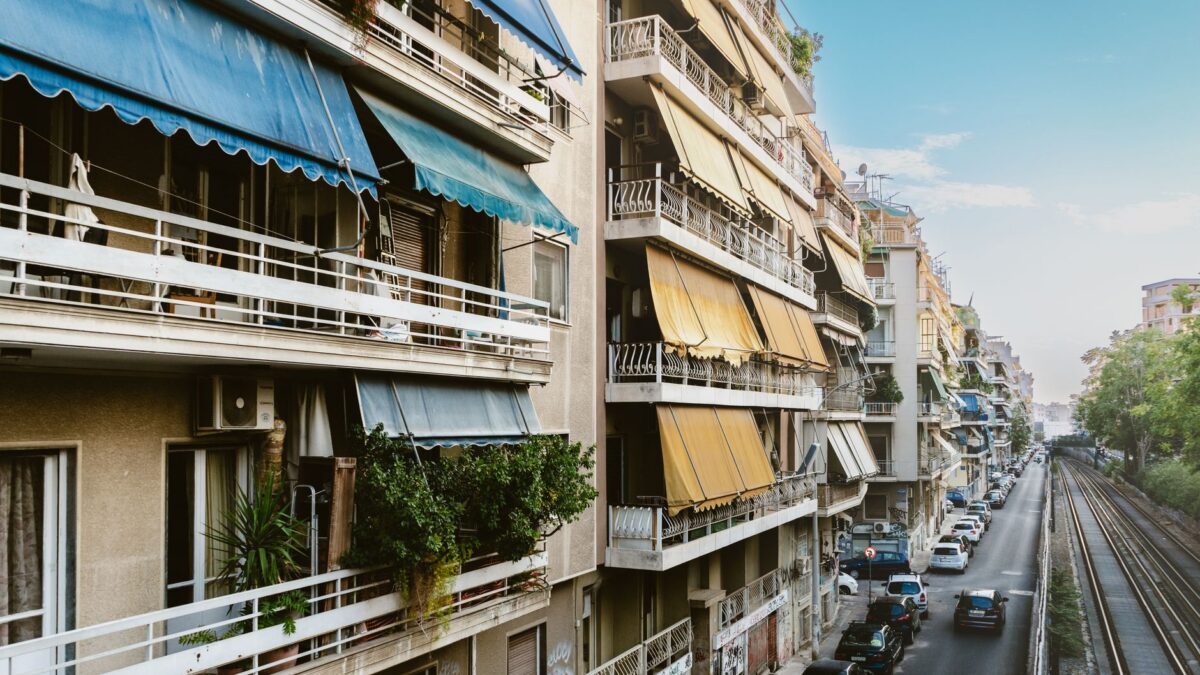
- Outdoors: move away from buildings, balconies, power lines and trees. In the narrow streets of central Athens, move to the widest open spot you can reach; falling plaster and balcony parts are the main danger.
- In a car: stop away from bridges and overpasses and stay inside until the shaking ends.
Shaking from Greek earthquakes usually lasts only seconds, which is why the advice focuses on reacting at once rather than moving far.
What should you do after the shaking stops?
- Check yourself and others for injuries. Call 166 or 112 for anyone badly hurt.
- Turn off gas at the cooker or meter and switch off the electricity if you smell gas or see damage.
- Leave by the stairs, never the lift, carrying your kit, and go to an open space away from buildings.
- Expect aftershocks. Do not go back inside a building with visible cracks in columns or beams until engineers have checked it.
- Follow official information on civil protection channels and keep phone calls short so the network stays free.
Municipalities have designated open-air gathering areas (choroi synkentrosis) for after a strong earthquake. The General Secretariat for Civil Protection publishes guidance, and many municipalities list their gathering areas on their sites. Find the one nearest your home now. Our guide to emergency numbers in Greece lists who to call.
Will a 112 alert warn you of an earthquake?
Greece’s 112 system sends alerts to phones in an area by cell broadcast. For earthquakes it is used mainly after a strong quake: for example, to tell people to stay out of damaged buildings or to warn of a tsunami risk on the coast. It is not an advance warning of shaking. Some phones run their own earthquake detection features, but those are not part of the official Greek system.
What should be in a home emergency kit?
| Item | Why |
|---|---|
| Water, a few liters per person | Mains water may stop after a strong quake |
| Torch and spare batteries | Power cuts and dark stairwells |
| Portable radio or charged power bank | Official updates if phone networks are busy |
| First aid kit and regular medicines | Pharmacies may be closed for a while |
| Copies of passport, residence permit, AMKA | Needed for aid, hospitals and replacement documents |
| Whistle, sturdy shoes, warm layer | Signalling for help; glass on the floor; nights outdoors |
Keep the kit near the door, and secure tall furniture, bookcases and water heaters to the wall. Our guides to wildfire season in Attica and heatwaves in Athens use the same kit idea for other hazards.
How can you judge a building’s safety when renting?
You cannot judge a building by eye, but you can ask useful questions. Find out the year the building permit was issued: buildings designed after 1985, and especially after 2000, follow stricter seismic rules than older ones. Ask whether the building was damaged in 1999 and repaired, and whether ground-floor shops have removed walls or columns, a known problem in older blocks. Wide diagonal cracks in columns or beams are a warning sign; fine cracks in plaster usually are not.
Landlords are not required to give you a structural report, and only a licensed civil engineer can assess a building. If you plan to buy, an engineer’s inspection is worth the fee. Our guide to renting an apartment in Athens covers the rest of the viewing checklist.
Bottom line
Pick your safe spot in each room now, the sturdy table, not the doorway. Then walk the route from your flat to the nearest open space once, so you know it without a map.
FAQ
Is Athens at high risk of a major earthquake?
Greece is highly seismic, and Attica has active faults, including the one behind the 1999 quake. Experts cannot predict when or where the next damaging earthquake will happen.
Should I stand in a doorway?
No. Official Greek advice is to take cover under a sturdy table and hold on. Doorways in modern flats offer little protection.
Where can I see recent earthquakes?
The Institute of Geodynamics of the National Observatory of Athens publishes a live list of recorded earthquakes with magnitude and location.
Does home insurance cover earthquakes?
Only if the policy includes earthquake cover. Many basic home policies do not, so check before you sign.