Plaka Athens Guide: Anafiotika, Museums and Quiet Corners
Plaka, the old neighbourhood under the Acropolis, is best explored on foot. Anafiotika, small museums and Byzantine churches reward a slow walk.
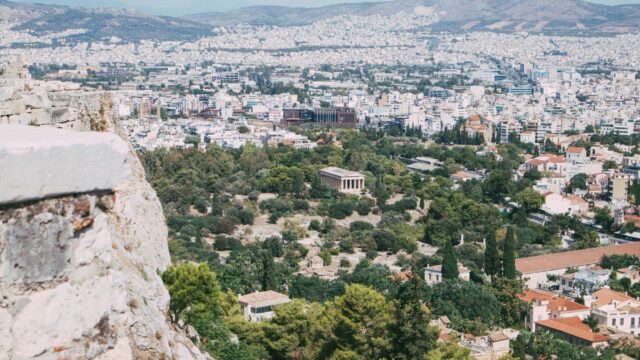
Plaka is the old neighbourhood on the northeastern slope of the Acropolis, between Syntagma and Monastiraki squares. The best way to see it, according to the official Athens guide, is to wander the lanes and watch for glimpses of the Acropolis between neoclassical buildings, Byzantine churches, cafes and shops. The places below are the quieter sights worth a detour, plus the museums that sit inside the neighbourhood.
A walk through Plaka can take in Anafiotika, a Byzantine church with a famous bell, an ancient monument from the theatre festivals and the oldest surviving house in Athens. Most of these are small and cost little time, which makes them easy to combine with a visit to the Acropolis or its museum.
How is Plaka laid out?
Adrianou Street is the largest and most central street in Plaka, according to Wikipedia’s entry on the neighbourhood. It splits the area in two: Ano Plaka (upper Plaka) sits right under the Acropolis, and Kato Plaka (lower Plaka) lies between Syntagma and Monastiraki. The official guide describes the area as running from Filomousson Square, roughly where Kidathinaion and Adrianou Streets meet, down to Monastiraki.
Plaka is one of the oldest inhabited districts of Athens. Some streets, including Adrianou and Tripodon, can be traced back to ancient times. For the longer story, see our piece on the history of Plaka and Anafiotika.
Anafiotika, Plaka
Anafiotika feels like a Cycladic island village set on the slope of the Acropolis. Workmen from the island of Anafi founded it, and the whitewashed houses, narrow paths, flower-filled planters and cats on every step still show it. The area is loosely marked by two 17th-century churches: Agios Georgios tou Vrahou (St George of the Rock) on the east and Agios Simeon on the west.
Follow the path as it narrows and a handmade sign points toward the Acropolis along Theorias, a stone-paved walk around the rock. Turn back toward Agios Georgios for a view reaching Lycabettus hill, with the city’s landmarks almost at eye level. Anafiotika suits anyone who wants a short, quiet walk away from the main shopping lanes.
Agios Nikolaos Ragavas, Plaka
This small domed church stands at the corner of Prytaniou Street and the steps of Epiharmou, with the Acropolis rising behind it. The official guide says the church was built over an ancient temple, whose columns show in the weathered outer walls. It gives the 9th century and the 11th century as dates for the building.
The church once belonged to the Ragavas family, a great Byzantine household. Its small bell is the part of the story most visitors enjoy: the guide says bells were banned under Ottoman rule and confiscated, but this one was hidden in a secret crypt. It rang in 1833 to mark the end of nearly 400 years of Ottoman occupation, and again on Oct. 12, 1944, after German troops withdrew.
Monument of Lysicrates, Plaka
The monument stands in an excavated square on the edge of Plaka, almost at right angles to Hadrian’s Arch and directly under the Acropolis cliff. It is an odd-looking structure: a podium topped by a solid tower with Corinthian columns built into it. In ancient times, wealthy sponsors of the drama festivals at the nearby Theatre of Dionysus put up similar monuments along this street as a sign of their patronage.
The cafes in the shaded square are a popular meeting point, and the official guide notes that Lord Byron wrote part of Childe Harold here. Locals call the site the “lantern of Dimosthenes”. Wikipedia adds that the name Plaka itself once applied only to the area around this monument.
The Pikionis Pathway
These stone-paved walks around Philopappou Hill, Dionysiou Areopagitou and the Acropolis were laid out in the 1960s by the architect Dimitris Pikionis. He used salvaged material from demolished buildings, pieces of ancient pottery, marble and stone fragments of no archaeological value, and modern concrete and brick, so that the path reads as a timeline of the city. The official guide says few people realise the paths are not ancient.
Benizelos Mansion, Plaka
The Benizelos Mansion is the oldest surviving house in Athens, and it looks nothing like the columned image most people have of the city. The restored 18th-century residence has a plain stone ground floor, small double windows and an arched portico around an inner courtyard. Look in the rear for storerooms and an olive or grape press. Wikipedia notes that the Benizelos family, from which Saint Philothei came, lived in Plaka.
Museums in Plaka
The Acropolis Museum is the headline sight, and we have a separate guide to tickets, hours and what to see on each floor. Smaller museums sit within the neighbourhood too. The official guide recommends the Museum of Greek Folk Art, the Folk Instruments Museum, and the private collections of art and antiquities at the Frissiras and Canellopoulos Museums.
Wikipedia also lists the Athens University Museum and the Jewish Museum of Greece. The Old Public Baths building is an annex of the Museum of Greek Folk Art. The sources do not give opening hours or ticket prices for any of these, so check each museum’s own website before going.
Tips for visiting without the crowds
- Plaka draws hundreds of thousands of tourists a year, according to Wikipedia, so the main lanes with souvenir shops are the busiest part. The sights above are small and easy to miss, which is a reason to go looking for them.
- Walk the area on foot and drift off the main streets. The official guide treats wandering as the best method.
- Pair the Monument of Lysicrates with a coffee in its square, then climb to Anafiotika.
- Check museum hours and prices on official pages before you plan a day around them.
Quick answers
Where does Plaka start and end?
It runs from Filomousson Square, roughly where Kidathinaion and Adrianou Streets meet, down toward Monastiraki, and sits between Syntagma and Monastiraki squares on the Acropolis slope.
Who built Anafiotika?
Workmen from the island of Anafi founded it, according to the official guide, drawn by familiar terrain and cheap land.
Is the Pikionis Pathway ancient?
No. Dimitris Pikionis laid the paths in the 1960s, using reclaimed and modern materials.
Checked against official sources in November 2026. Hours, prices and rules change: confirm on the official page before you go or apply.