Roman Athens Walk: Roman Agora, Library and Tower of the Winds
A short walk through Roman Athens links the Roman Agora, Hadrian's Library and the Tower of the Winds. Dates, layout and what survives at each.
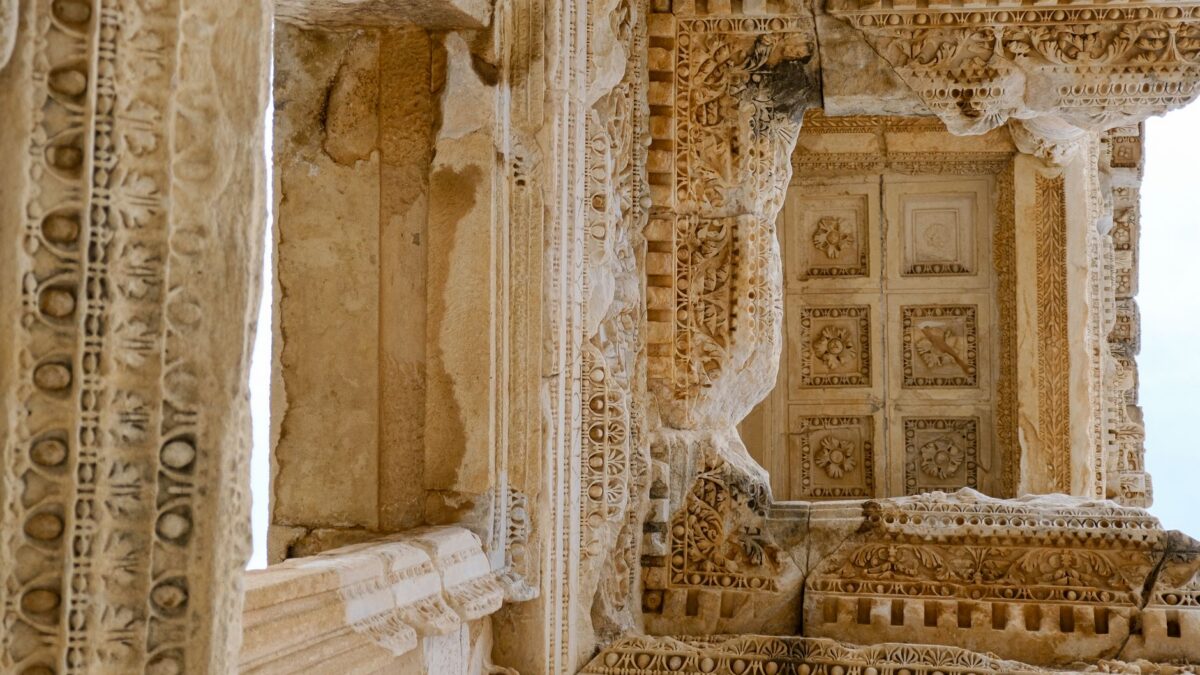
The Roman Agora, Hadrian’s Library and the Tower of the Winds sit close together north of the Acropolis, and each can be seen in one short walk through Roman Athens. The Roman Agora was built east of the original agora in the years before the Common Era, Hadrian’s Library followed in AD 132, and the Tower of the Winds stands at the agora’s eastern edge. The descriptions below draw on three Wikipedia pages: Roman Agora, Hadrian’s Library and Tower of the Winds.
Roman Agora, east of the Ancient Agora
The Roman Agora is a ruined market square lying around 100 metres east of the original agora and north of the Acropolis. Eucles of Marathon built it between 27 BC and 17 BC, or possibly in 10 BC, with money donated by Augustus. The donation kept a promise Julius Caesar had made in 51 BC. For the original square, see the article on the Ancient Agora and the Stoa of Attalos.
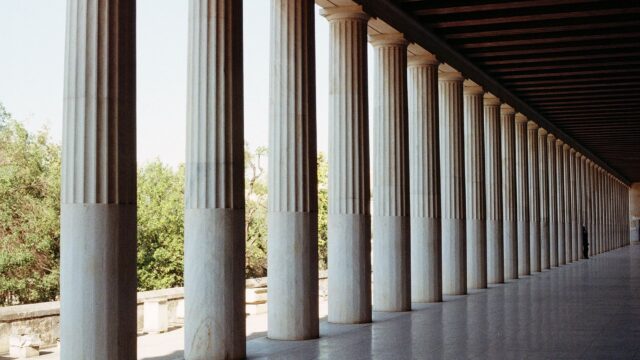
The site has not been fully excavated. It was an open space surrounded by a peristyle (a colonnade), with a fountain to the south. On the west, behind a marble colonnade, stood shops and a Doric entrance known as the Gate of Athena Archegetis. An Ionic gate, the East Propylon, stood on the east side next to the Tower of the Winds and a set of public toilets. An inscription mentions an Agoranomion, an office for market officials. Another inscription on the Gate of Athena Archegetis records a decree from Hadrian’s reign on the tax obligations of oil merchants.
Location: east of the Ancient Agora, north of the Acropolis.
Hadrian’s Library, north of the Acropolis
Emperor Hadrian had the library built in AD 132 on the north side of the Acropolis. It followed the layout of a Roman forum: one entrance through a Corinthian propylon, a high outer wall with niches along the long sides, and an inner courtyard of columns with a long decorative pool in the middle. The main entrance belonged to the Stoa of Hadrian, with columns of Karystian marble. The building opened onto the Roman agora, which was the oil market, by a porch and pediment.
Papyrus rolls were kept in cupboards and shelves on the eastern side. Neighbouring halls were reading rooms, and the corners were lecture halls. The ceilings were gilded wood, and the walls were covered in marble and paintings.
The Herulian invasion of 267 seriously damaged the building. The prefect Herculius repaired it between 407 and 412, and it was later built into the Roman city walls. Three churches rose on the site in Byzantine times, and their remains are preserved: a tetraconch from the 5th century, a three-aisled basilica from the 7th century and a simple cathedral from the 12th century. That cathedral, known as Megali Panagia, was the first cathedral of the city. A colossal statue of the goddess Nike, found in the library in 1988, is shown on the site.
Management: the Minister for Culture. Getting there: Monastiraki station.
Tower of the Winds, Roman Agora
The Tower of the Winds (Ωρολόγιο του Κυρρήστου in Greek) is an octagonal tower of Pentelic marble in the Roman Agora. It is named after the eight large reliefs of wind gods carved around its top. Its date is uncertain, but it was finished by about 50 BC, because the writer Varro mentioned it around 37 BC. It is the only surviving clock tower from classical antiquity, and one of the few ancient buildings still standing almost intact.
The tower is 12 metres tall with a diameter of about 8 metres, and it rises on three steps. The wind gods carved on the frieze are Boreas, Kaikias, Apeliotes, Eurus, Notus, Livas, Zephyrus and Skiron. Below them are eight sundials. A water clock inside was driven by water from the Acropolis, and holes and channels in the floor remain, although the mechanism is gone. According to Vitruvius, a bronze Triton once topped the tower as a weather vane. It has disappeared.
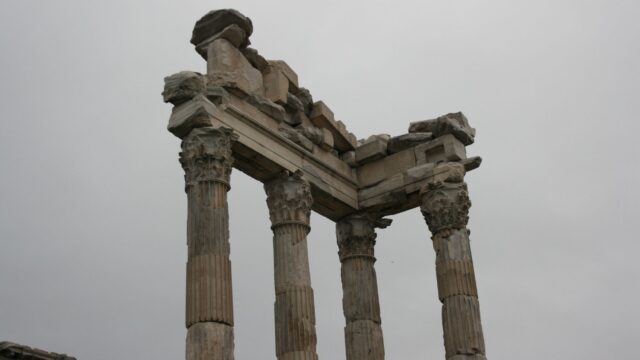
The roof is essentially original, made of 24 trapezoidal stone slabs held by a circular keystone. Two porches with Corinthian columns once stood at the front, and the lower parts of three columns remain. The designer, Andronicus of Cyrrhus, seems to have written a book on the winds. It is unclear how readings from the water clock reached people outside, so visitors may have had to go in.
Tips for visiting
The sources give no opening hours or ticket prices for the three sites. Check the official pages for current hours and tickets before you go. The Ancient Agora and Kerameikos are other ancient sites in the city. Our guide to Kerameikos, the ancient cemetery and museum covers one of them.
A sensible order: start at Hadrian’s Library near Monastiraki station, move into the Roman Agora next to it, and finish at the Tower of the Winds on the agora’s east side.
Quick answers
Who built the Roman Agora?
Eucles of Marathon built it with funds from Augustus, between 27 BC and 17 BC or possibly in 10 BC.
What is the Tower of the Winds?
It is an octagonal marble tower in the Roman Agora, finished by about 50 BC, with reliefs of eight wind gods, eight sundials and a former water clock.
How do you reach Hadrian’s Library by public transport?
The nearest station is Monastiraki.
Checked against official sources in November 2026. Hours, prices and rules change: confirm on the official page before you go or apply.